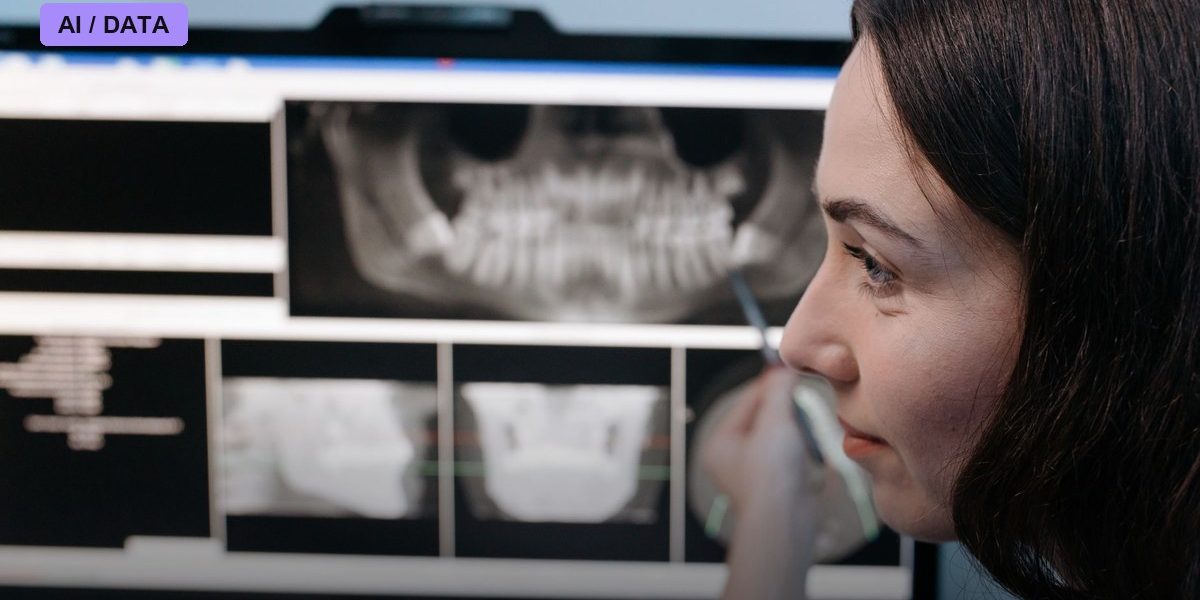
An American Dental Association survey covered in August 2026 found that 43.3% of US dentists are already using AI for at least one clinical task, most commonly analyzing X-ray images and intraoral scans to flag cavities and other dental conditions before they become visible to the naked eye, a rapid adoption curve for a technology that barely existed in mainstream dental practice five years ago. The same Health Policy Institute survey found another 26.4% of dentists planning to adopt AI tools in the near future, while a narrower 22.8% specifically reported using AI for imaging and diagnostic work such as reading X-rays, and among dentists already using AI, 82% named radiograph interpretation as their leading application.
How AI Cavity Detection Actually Works
FDA-cleared tools including Pearl, Overjet, and VideaHealth read dental radiographs and cone-beam CT scans, comparing pixel-level patterns against massive reference databases of confirmed cavities and other pathology to flag subtle early-stage decay that can be difficult for even experienced clinicians to catch consistently on a busy exam schedule. The technology functions similarly to AI tools already used in radiology and pathology, applying pattern recognition trained on enormous labeled image datasets to a diagnostic task that has traditionally depended entirely on individual clinician visual inspection. At Nuffield Dental, for example, staff describe software capable of identifying bone loss around teeth with sub-millimeter accuracy and of overlaying a patient’s current scan directly on top of images from a prior visit, letting both dentist and patient see exactly where and how much a lesion has changed since the last appointment.
Consumer Apps Are Bringing the Technology Home
Beyond clinical settings, consumer smartphone apps now let people photograph their own teeth and receive an instant, clinical-style dental health assessment including cavity risk scoring, while separate at-home intraoral scanning services promise full dental reports delivered within about ten minutes. These consumer tools represent a meaningful expansion of dental self-screening capability, particularly valuable for people who face barriers to regular dental visits, cost, access, dental anxiety, though they raise obvious questions about accuracy compared to professional in-office equipment and oversight.
The Case for Rapid Adoption
Dentists who have integrated AI scanning into daily practice describe the tools as catching early-stage decay that would otherwise go undetected until a cavity has progressed further, when treatment becomes more invasive and costly, framing AI cavity detection as fundamentally preventive technology rather than merely a diagnostic convenience. Practice management researchers note that AI-assisted image review also helps standardize diagnosis across dentists with varying experience levels, potentially reducing the well-documented variability in how differently trained clinicians read the same radiograph. Practices that have adopted AI scanning tend to skew larger and better resourced, since the software works best paired with newer intraoral scanning systems, and most clinics fold the AI review into the cost of a standard exam rather than billing it as a separate line item, a structure dentists say has helped speed patient acceptance.
Where Skepticism Persists
Critics, including some dental researchers and patient advocates, worry that AI cavity-flagging tools could push overtreatment, since a system trained to maximize sensitivity toward catching every possible early lesion may flag borderline cases that would never have progressed to a clinically significant cavity, potentially leading to unnecessary fillings billed to patients or insurers. There’s also concern that at-home consumer scanning apps, operating without professional oversight or calibrated equipment, could either falsely reassure users with early-stage problems the app misses, or generate unnecessary anxiety over ambiguous results that a trained dentist would interpret differently in the context of a full clinical exam. Even in clinical settings, the tools still can’t independently diagnose or recommend treatment, and they have no way to factor in symptoms a patient reports out loud, tooth sensitivity or pain, without a dentist weighing that information alongside the flagged image; reporting on the technology’s rollout notes it tends to struggle most with unusual anatomy, lower-quality scans, and rarer conditions that fall outside its training data, generating false positives that still require a clinician’s judgment call before any filling gets recommended.
What Happens as Adoption Keeps Climbing
With adoption already above four in ten US dental practices and climbing, the next phase for the category is likely increased scrutiny of exactly how AI cavity-detection accuracy compares to experienced dentists across diverse patient populations and imaging equipment, research that so far has lagged the pace of clinical deployment. Dental insurers are also watching closely, since AI-flagged findings that influence treatment recommendations could eventually affect how claims are evaluated and reimbursed, adding dentistry to the growing list of medical specialties navigating how AI diagnostic assistance intersects with billing and coverage decisions. Dental schools have also begun adjusting curricula to teach incoming dentists how to interpret and, when necessary, override AI-flagged findings, reflecting a broader recognition across healthcare training programs that the more urgent skill going forward may not be reading an X-ray from scratch, but knowing when to trust, question, or overrule what an algorithm has already flagged.
Photo: cottonbro studio / PEXELS via Pexels