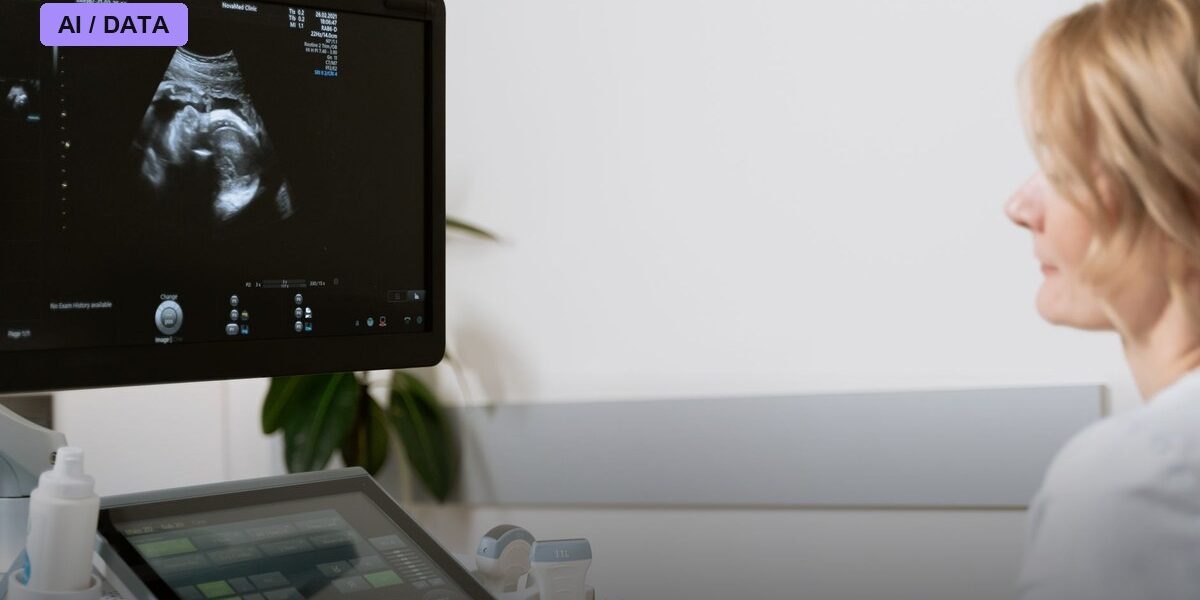
At the American Heart Association’s annual Scientific Sessions in Chicago, held November 6–9, Kaiser Permanente Northern California presented one of the largest real-world tests yet of AI-drafted cardiology reports, and the results complicate the industry’s usual pitch that AI simply makes doctors faster without changing accuracy. Researchers reviewed 1,200 echocardiograms performed across 21 Kaiser Permanente Northern California medical centers, comparing reports drafted by an AI model against reports drafted entirely by cardiologists, before a human physician reviewed and finalized every report in both arms.
The Headline Numbers
Cardiologist time spent per study fell from an average of 8.5 minutes to 4.6 minutes when starting from an AI-generated draft — a reduction of roughly 46% in hands-on review time, which at scale could translate into meaningfully more reading capacity for a health system handling tens of thousands of echocardiograms a year. But the study also found that AI-drafted reports needed major revision 50.6% of the time, compared with 49.7% for human-drafted reports — statistically indistinguishable. In other words, the AI did not produce more accurate first drafts than cardiologists; it simply let physicians get to a finished, corrected report faster.
Why That Distinction Matters
The finding cuts against a common assumption in AI-in-medicine coverage, where efficiency gains are often implicitly treated as accuracy gains. Kaiser’s data suggests the opposite: the AI model is functioning as a fast first-pass drafting tool rather than a more accurate diagnostician, with cardiologists still needed to catch roughly half of all reports that require substantive correction. A MarketScale analysis of the presentation noted that none of the AHA 2026 echocardiogram studies, including this one, established any reduction in hard clinical events such as missed diagnoses leading to adverse outcomes — the studies measured workflow efficiency and report concordance, not downstream patient harm or benefit.
How This Compares to Other AHA 2026 Findings
The Kaiser study arrived alongside other AI-cardiology research at the same conference, including Cleerly’s PARAMOUNT trial, which found AI-guided heart scans outperformed stress testing on certain diagnostic measures. Together, the studies reflect a conference-wide pattern: AI tools are clearing meaningful technical bars — faster turnaround, comparable or better diagnostic concordance on specific tasks — without yet producing the kind of hard-outcomes evidence (fewer deaths, fewer missed heart attacks) that would justify treating them as a standard of care rather than a productivity aid. That pattern mirrors findings elsewhere in AI medicine this year, including a UK primary-care trial of an “AI Consult” tool that improved clinical decision quality without significantly changing hospitalization or mortality rates.
The Workflow Case for Adoption
Proponents of AI drafting tools argue that the time savings alone justify deployment, particularly at large systems like Kaiser Permanente Northern California, which operates one of the busiest integrated cardiology programs in the country. Freeing nearly four minutes per study, multiplied across thousands of monthly echocardiograms, could reduce reporting backlogs, cut overtime costs, and let cardiologists spend more time on complex cases rather than routine report-writing. Hospital executives surveyed in Guidehouse’s 2026 Healthcare AI Trends report have cited exactly this kind of incremental efficiency gain as the most defensible near-term return on AI investment, even as nearly half of those same executives say their organizations are not yet operationally ready to govern AI deployments at scale.
The Caution From Skeptics
Critics point to the revision-rate parity as the more important number: if an AI draft is wrong as often as a human draft, health systems need robust review processes to ensure the roughly 50% of flawed reports are consistently caught, not just quickly produced. A rushed cardiologist reviewing a confident-sounding AI draft under time pressure could, in theory, be more likely to accept a flawed interpretation than one reviewing a blank page — a dynamic sometimes called automation bias that has not been directly measured in this study. Researchers have called for longer-term follow-up tracking whether the speed gains hold up once systems scale deployment beyond a controlled 1,200-study sample, and whether faster throughput changes how carefully reports get reviewed.
What’s Next
Kaiser Permanente has not announced a timeline for expanding the AI drafting tool beyond the study cohort, and the underlying model and vendor were not detailed in available coverage of the AHA presentation. The broader field is moving toward larger, outcomes-focused trials — including NEJM AI publications on AI deterioration-index alerts and ongoing FDA review of generative AI radiology report tools — that aim to finally answer whether faster AI-assisted documentation translates into better patient outcomes, or simply reallocates clinician time without changing the rate of missed or incorrect diagnoses.
Photo: MART PRODUCTION / PEXELS via Pexels