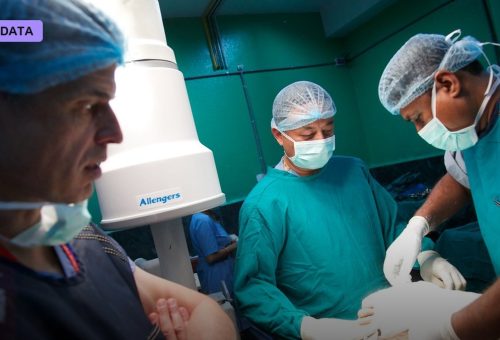
Bia Health, a Quebec City-based health-tech company, has raised C$2.15 million to expand an AI assistant designed to help clinicians decide when a patient actually needs imaging, a referral, or another intervention, rather than ordering one by default. The round, disclosed October 14, combines C$1.4 million in debt financing from Montreal’s Finalta Capital with an equity tranche led by Anges Québec and backing from Desjardins through its Startup en résidence program, alongside a group of physician angel investors. The debt-equity split is notable for a raise this size: Finalta Capital specializes in revenue-based and venture debt financing for Quebec startups with established recurring revenue, meaning lenders were already treating Bia’s existing continuing-education business as collateral-worthy before the newer AI assistant product had its own standalone financial track record.
The Problem: Low-Value Care at Scale
Bia’s pitch rests on a widely cited estimate that roughly 30% of healthcare spending in Canada goes toward low-value or unnecessary care, including imaging studies, specialist referrals, and procedures that don’t change a patient’s treatment course. CEO Anne-Sophie Paquet has framed the company’s goal as helping frontline clinicians apply current clinical evidence at the point of care, rather than defaulting to imaging or referral out of caution or habit, a pattern that drives both cost and patient anxiety without necessarily improving outcomes.
From E-Learning Platform to Clinical Decision Tool
Bia Health didn’t start as an AI company. Founded in 2016, it began as an e-learning and medical content library aimed at keeping clinicians current on evidence-based practice guidelines. According to the company, its founders eventually concluded that simply publishing updated evidence wasn’t moving the needle on actual care decisions, which led to the development of the Bia Assistant, a point-of-care tool that surfaces evidence-based recommendations directly into a clinician’s workflow when they’re deciding whether an imaging order or referral is warranted.
Early Traction and Where the Money Goes
The company has reported roughly C$500,000 in annual recurring revenue, and its earlier continuing-education platform is already used by thousands of health professionals across Quebec, giving it an existing distribution channel into clinics as it pushes the assistant product further. The new funding is earmarked for expanding Bia Assistant’s rollout into clinics, teleconsultation platforms, and larger healthcare organizations beyond its current Quebec base, with the debt portion of the round specifically structured to fund that commercial scale-up rather than product development.
A Crowded Field of AI Triage Tools
Bia enters a Canadian health-tech landscape that has already produced AI imaging and diagnostic startups like Imagia and Oncoustics, though Bia’s focus on reducing imaging orders rather than interpreting them places it in a smaller category of tools aimed at utilization management rather than diagnostic accuracy. That distinction matters commercially too: diagnostic-interpretation tools typically need to prove they match or beat radiologist accuracy to win adoption, while utilization-management tools like Bia’s instead have to prove they save money and reduce patient burden without introducing new liability for the ordering physician, a different and in some ways harder sell to risk-averse hospital administrators. Physician investors backing the round suggest at least some clinical buy-in, but the company has not published independent, peer-reviewed data quantifying how much the assistant actually reduces unnecessary imaging or referral rates in real clinical settings.
Caution From the Company Itself
Bia Health has been explicit that the assistant is meant to support, not replace, clinical judgment, a distinction that matters both for liability and for clinician adoption, since tools perceived as overriding physician decision-making tend to face resistance regardless of their underlying accuracy. That framing also sidesteps some of the regulatory scrutiny that tools making direct diagnostic or treatment claims can attract, positioning Bia closer to a decision-support reference than a medical device making autonomous recommendations.
What’s Next
Bia Health has not disclosed specific clinic partnerships or a timeline for its expansion beyond Quebec, though the structure of the new funding, half debt and half equity, suggests the company is betting on near-term revenue growth from existing relationships rather than a long runway toward profitability. Whether the tool meaningfully reduces low-value imaging at scale, and whether larger health systems outside Quebec are willing to adopt a workflow tool built by a smaller regional player, will likely determine whether the company’s next funding round looks similar or considerably larger.
Photo: Anna Shvets / PEXELS via Pexels