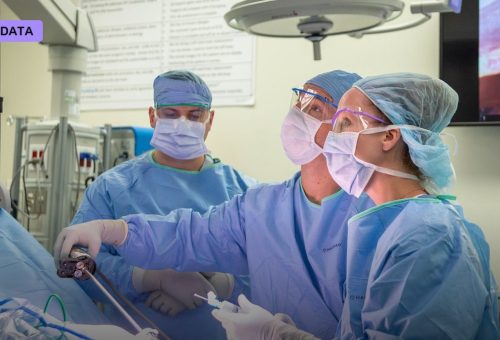
A Philips survey of clinicians released this month found that 67% of those who use AI diagnostic tools say the technology has improved the speed of their decision-making, while just 3% said they would be comfortable letting AI decide and act independently without a human reviewing its recommendations. The gap between enthusiasm for AI as a speed booster and deep reluctance to cede clinical authority captures where hospital AI adoption actually stands today, well short of the autonomous-diagnosis future often described in AI marketing materials.
What the survey measured
Philips, a longtime medical imaging and health technology company with its own portfolio of AI-enabled diagnostic products, surveyed practicing clinicians about their attitudes toward AI tools already integrated into their workflows — imaging triage systems, documentation assistants and decision-support software — rather than hypothetical future products. The 67% figure on speed improvement suggests meaningful real-world time savings are already being realized in clinical settings where AI tools have been deployed, a notable finding given how much skepticism has historically surrounded whether AI tools deliver on efficiency promises once they leave controlled pilot studies.
Why trust lags so far behind speed gains
The near-unanimous reluctance to let AI act autonomously reflects both professional and legal realities facing clinicians: physicians remain personally and legally responsible for patient outcomes regardless of what an algorithm recommends, giving them strong incentive to treat AI output as a second opinion rather than a final answer. It also reflects well-documented limitations of current clinical AI systems, which can perform impressively on benchmark datasets while still making errors that a human physician with full context would be more likely to catch — the kind of failure mode that erodes trust quickly even when overall statistical performance looks strong.
Context: a year of notable clinical AI benchmarks
The survey lands in a year that has seen some genuinely striking AI diagnostic results reach publication, including a Harvard and Beth Israel study published in Science in April showing an OpenAI reasoning model outperforming experienced emergency physicians on real-world diagnostic cases using only the information available at the time, and Microsoft’s MAI-DxO system posting strong results on a separate diagnostic benchmark in October. Yet researchers behind both studies have been explicit that benchmark performance does not substitute for prospective, real-world hospital trials — exactly the gap the Philips survey’s trust numbers seem to reflect among practicing clinicians who have actually used these tools day to day.
The counter-argument from AI vendors
Health-AI companies and some hospital administrators argue that framing AI as needing to earn full autonomous trust sets the wrong bar entirely — the near-term value of these tools, they say, lies precisely in speeding up and augmenting human judgment rather than replacing it, and the Philips survey’s own speed-improvement figure validates that this value is already being realized at scale. Under this view, low trust in full AI autonomy isn’t a failure of the technology so much as an appropriate, durable division of labor between statistical pattern-matching and human clinical judgment that is likely to persist for years regardless of how much AI models improve.
What it means going forward
The survey suggests the near-term commercial path for clinical AI runs through augmentation rather than automation — tools that save clinicians time on documentation, triage and preliminary analysis while leaving final judgment calls with humans. For AI vendors and hospital systems investing heavily in these tools, the data offers a mixed signal: strong validation that efficiency gains are real and valued, paired with a clear ceiling on how much clinical authority physicians are currently willing to delegate, a ceiling that is unlikely to move until clinical AI systems demonstrate sustained, transparent accuracy across the messy, poorly documented cases that make up much of real-world medicine.
Photo: ovariancancer1 / PIXABAY via Pixabay