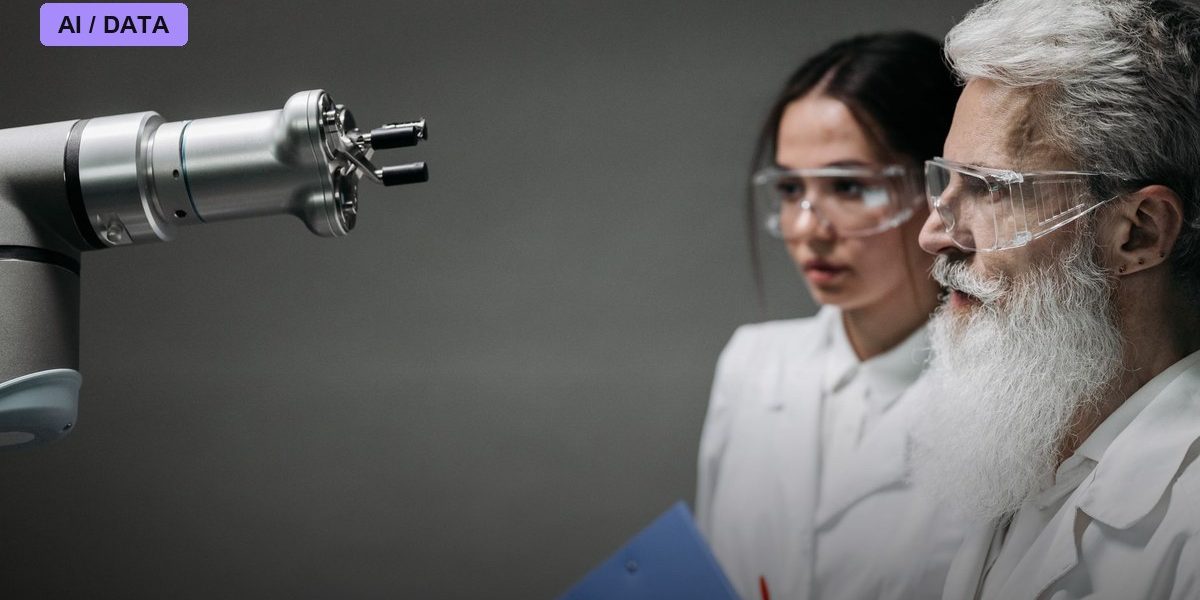
NVIDIA and Eli Lilly and Company have announced a new AI co-innovation lab that the two companies say will invest up to $1 billion in talent, infrastructure and compute over the next five years, one of the largest single commitments yet to fuse artificial intelligence with the physical, wet-lab side of pharmaceutical research. The lab, based in the San Francisco Bay Area, is designed to physically co-locate Lilly’s biologists, chemists and medicinal scientists alongside NVIDIA’s AI model builders and engineers, rather than treating drug discovery software as something built separately and handed off to lab scientists afterward.
Why the two companies are pairing up now
The announcement reflects a broader shift underway across the pharmaceutical industry, where AI has moved beyond analyzing existing chemistry and biology data toward actively designing and testing new molecules. Lilly, the maker of blockbuster diabetes and obesity drugs including Mounjaro and Zepbound, has spent heavily to build internal AI capability but has said it still needs deeper computing infrastructure and model expertise to keep pace with the volume of biological data modern drug discovery generates. NVIDIA, for its part, has increasingly positioned its chips and software platforms as essential plumbing for biology and chemistry research, following the same playbook that made it central to the broader AI computing boom.
Robotic wet labs talking to AI models in real time
The core technical idea behind the lab is what the companies call a continuous learning system connecting Lilly’s agentic, robot-operated wet labs to computational dry labs, enabling round-the-clock AI-assisted experimentation. In practice, that means robots running actual chemistry and biology experiments feed results back into AI models almost immediately, and those models in turn suggest the next experiment to run, closing a loop that traditionally took human scientists days or weeks to complete manually. NVIDIA and Lilly describe this as a scientist-in-the-loop framework, meaning human researchers still set direction and interpret results, but the mechanical cycle of proposing, running and evaluating experiments is increasingly automated and never stops running.
The computing backbone: BioNeMo and Vera Rubin
The lab’s infrastructure will run on NVIDIA’s BioNeMo platform, a set of AI tools purpose-built for biology and chemistry modeling, alongside NVIDIA’s next-generation Vera Rubin computing architecture. Vera Rubin represents NVIDIA’s newest generation of AI infrastructure hardware, and pairing it directly with a pharmaceutical partner signals how central drug discovery has become to NVIDIA’s pitch for its most advanced chips, alongside more familiar customers in cloud computing and large language model training. The two companies also plan to pioneer robotics and what they call physical AI, extending automation beyond software into the mechanical process of running lab experiments and, eventually, scaling up production of promising compounds.
Opening some of the tools to outside biotechs
Beyond the Bay Area lab itself, Lilly is expanding TuneLab, a platform that already gives outside biotechnology companies access to select Lilly AI models built on the company’s decades of proprietary drug discovery data. The partnership will add NVIDIA Clara, a set of open foundation models for life sciences, into TuneLab, effectively letting smaller biotech firms that lack Lilly’s or NVIDIA’s scale tap into some of the same underlying AI infrastructure. That move echoes a strategy already visible elsewhere in the industry, where large pharmaceutical companies increasingly monetize their AI tooling rather than keeping it entirely proprietary, betting that a broader ecosystem of AI-assisted drug discovery ultimately benefits everyone involved, including themselves.
Reasonable skepticism about the timeline
Big, expensive AI-pharma partnerships have proliferated over the past two years, and not all of them have yet produced approved drugs or even late-stage clinical candidates that can be directly credited to the technology. Industry analysts covering the deal have noted that a five-year, billion-dollar commitment is a long horizon by pharmaceutical standards, and that translating faster experimental cycles into an actual approved medicine still requires clearing human clinical trials, which AI cannot shortcut regardless of how quickly a robotic lab can screen candidate molecules. Lilly and NVIDIA executives have framed the lab as a long-term infrastructure bet rather than a promise of near-term drugs, acknowledging that the payoff, if it comes, is likely years away.
What it signals for the AI-health sector
Even with that caveat, the scale of the commitment marks a new benchmark for how seriously major pharmaceutical companies are willing to invest in AI-native infrastructure, rather than simply licensing existing AI tools from vendors. For an industry still sorting out which AI drug discovery bets will actually shorten the notoriously long and expensive path from lab bench to pharmacy shelf, the NVIDIA-Lilly lab is now one of the clearest signals yet that the biggest players intend to build that capability themselves, at a scale few competitors can currently match.
Photo: Pavel Danilyuk / PEXELS via Pexels