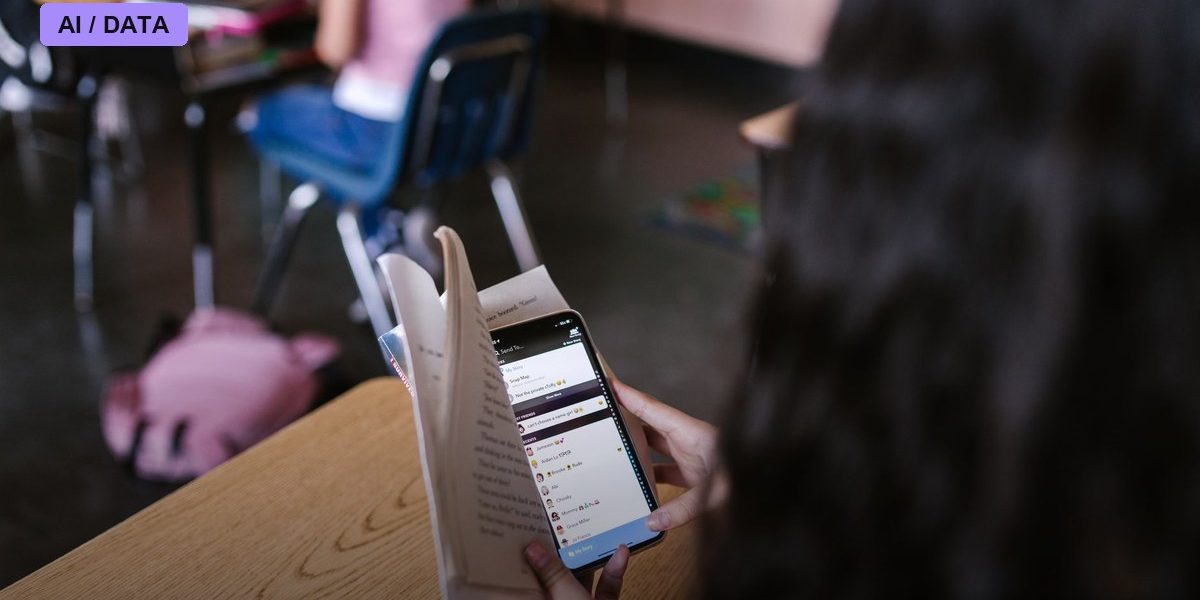
In classrooms across 22 middle schools in a large southeastern U.S. state, researchers at the University of North Carolina at Chapel Hill have been tracking something that would have sounded far-fetched five years ago: sixth, seventh, and eighth graders who say they prefer talking to an AI chatbot over a human classmate. The study, still under peer review as of late September 2026 and first reported by The Wall Street Journal, surveyed more than 2,300 students in two waves, one in December 2025 and a follow-up in spring 2026, and the trend line it found is not reassuring.
Use of AI chatbots among the surveyed students rose from 62% in December 2025 to 75% by spring 2026, a jump of 13 percentage points in roughly four months. Within that broader pool, about one in five students reported using AI specifically for emotionally intimate companionship, meaning they talked to a chatbot about feelings, problems, or relationships the way they might confide in a friend. The researchers found something more specific and more worrying: in every classroom surveyed, an average of two to four students said they now prefer interacting with a chatbot over a human peer.
Loneliness came first, not second
The study’s design let researchers test for direction, not just correlation. Students who relied on AI for friendship in the first survey wave were more likely to report greater loneliness when they were surveyed again months later. The same group also showed higher rates of social anxiety and depressive symptoms in the follow-up. That ordering matters: it suggests the chatbot use is not simply a symptom of kids who were already isolated reaching for a coping tool, but a pattern where the AI relationship itself appears to feed the isolation it was arguably meant to solve.
Why middle school is the pressure point
Mitch Prinstein, co-director of UNC’s Winston Center on Technology and Brain Development and one of the study’s authors, has been blunt about why this age group worries him more than, say, college students experimenting with the same tools. Early adolescence is when the brain is laying down the social skills, the back-and-forth of reading tone, managing conflict, and tolerating rejection, that people rely on for the rest of their lives. “When kids replace human relationships with chatbots, they’re missing major learning opportunities to develop the interpersonal skills they’ll need for a lifetime,” Prinstein said. He has also called the broader trend “a pretty existential concern for this generation,” language that is strong for an academic researcher but reflects how fast the adoption curve moved in a single school year.
The legal backdrop
The UNC findings land against a legal backdrop that has already made AI companionship for minors a matter of litigation, not just research. Google and Character.AI reached a settlement over a wrongful-death lawsuit brought by Megan Garcia, whose 14-year-old son died after prolonged, emotionally intense conversations with a Character.AI chatbot. That case, which predates the UNC study, has become a reference point for lawmakers and parents alike whenever new data on kids and AI companionship emerges, and it gives the Chapel Hill numbers a sharper edge than a typical education-technology survey would carry.
Not every researcher reads the data the same way
It is worth noting what the UNC study does not establish. It is observational, not a controlled trial, and the authors themselves describe the work as still undergoing peer review, meaning the specific effect sizes could shift before formal publication. Researchers in the broader AI-companionship literature have also found more mixed results: some studies of AI companion use among adults report that chatbots can meaningfully reduce loneliness in the short term, especially for people with very limited existing social networks, and caution against treating every instance of AI companionship as harmful by default. The honest reading of the field right now is that outcomes seem to depend heavily on whether a chatbot supplements a person’s social life or starts to replace it, and middle schoolers, UNC’s data suggests, are substituting rather than supplementing at a troubling rate.
What happens next
The UNC team’s findings are expected to move through formal peer review and publication in the coming months, which will let other researchers scrutinize the methodology more closely. In the meantime, the data is already filtering into policy conversations: several state legislatures, including Pennsylvania, have advanced bills in 2026 that would require new safeguards on AI chatbots marketed to or used by children. Parents, for their part, are left with a much blunter signal than any academic paper: a measurable share of middle schoolers are choosing an algorithm’s attention over a classmate’s, and the schools and families around them are only beginning to figure out what, if anything, to do about it.
Photo: RDNE Stock project / PEXELS via Pexels