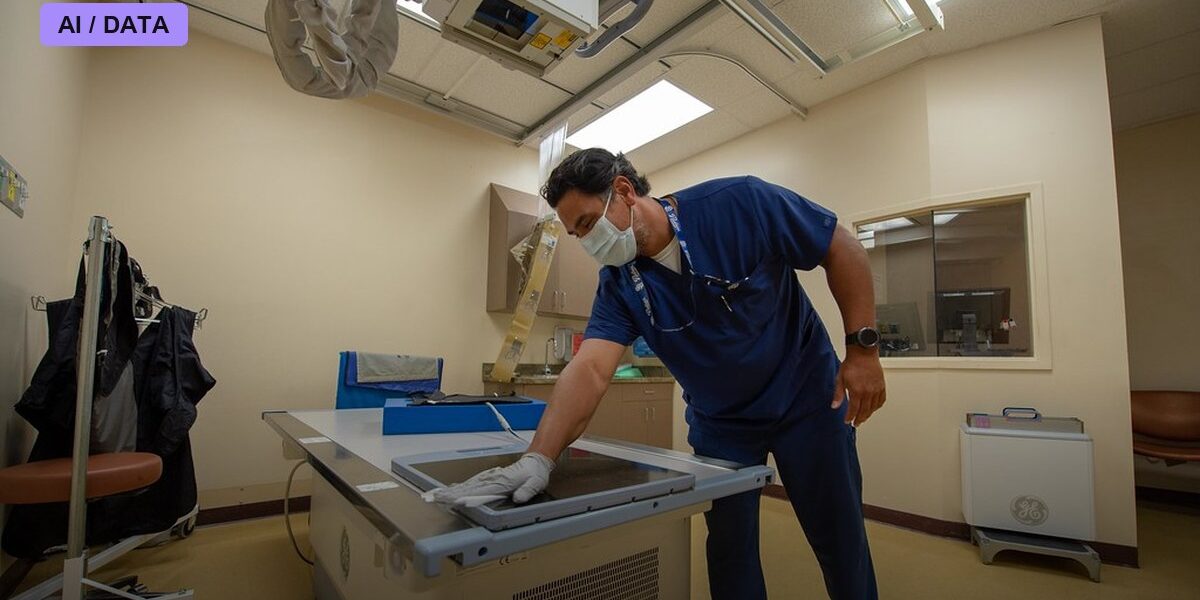
GE HealthCare announced on November 17 that the Food and Drug Administration cleared an updated version of its Critical Care Suite, an AI-powered feeding-tube detection tool that runs directly on the company’s mobile X-ray devices rather than relying on a cloud connection. The clearance, covering Critical Care Suite 3.0, marks the first time the detection algorithm has been extended to pediatric patients across GE’s installed base of bedside imaging machines.
Why Feeding-Tube Placement Is a Patient-Safety Problem
Misplaced feeding tubes are a persistent and dangerous complication in intensive-care units: a tube that enters the lungs instead of the stomach can deliver nutrition or medication directly into a patient’s airway, a mistake that has caused serious injury and death in hospitals even when bedside nurses and radiologists follow standard verification protocols. Critically ill patients, who are more likely to need feeding tubes placed urgently and repeatedly, are especially vulnerable because repeat X-rays to confirm placement add delay and radiation exposure.
On-Device AI, No Cloud Required
What distinguishes GE’s approach is that the detection software runs on the mobile X-ray unit itself at the point of capture, flagging a potential misplacement within moments of the image being taken rather than after it is sent to a radiologist’s workstation for review. That on-device architecture matters for hospitals with inconsistent network coverage in ICUs and for off-hours scans when a radiologist may not immediately review the image. GE says the tool is intended as a triage aid that alerts bedside clinicians to a suspected problem, not a replacement for radiologist sign-off.
Extending Coverage to Children
The pediatric extension is the clearance’s most significant clinical expansion. Feeding-tube misplacement carries outsized risk in neonatal and pediatric ICUs because smaller anatomy leaves less margin for error, and pediatric imaging has historically lagged adult imaging in AI tool development because training data sets are smaller and more tightly regulated. GE’s clearance indicates its algorithm has now been validated against a pediatric imaging data set sufficient to meet FDA’s performance bar for that population, though the company has not published the specific sensitivity and specificity figures from its submission.
Part of a Broader November Wave of Imaging Clearances
GE’s clearance came in the same week as at least two other AI-imaging clearances: a2z Radiology AI’s third FDA-cleared triage tool, a2z-Omni-Triage, for abdominopelvic CT scans, cleared November 19, and Siemens Healthineers’ Syngo.CT Coronary Cockpit, an AI tool for characterizing coronary artery plaque, also cleared that week. Industry trackers estimate the FDA has now cleared more than 1,000 AI- and machine-learning-based medical devices, the overwhelming majority through the lower-friction 510(k) pathway rather than full premarket approval, a regulatory pattern that has drawn scrutiny from some patient-safety advocates who argue the pathway was not designed for software that continues to learn and update after clearance.
What’s Next for Bedside AI Triage
GE HealthCare has not said when Critical Care Suite 3.0 will begin shipping to hospitals that already operate its mobile X-ray fleet, though software updates to cleared devices typically roll out faster than new hardware sales. The clearance adds to a growing category of point-of-care AI tools that aim to catch life-threatening errors before a human reviewer sees the image, a shift clinicians say is less about replacing radiologists than about compressing the time between a mistake happening and someone noticing it. Hospital systems evaluating the update will likely watch for real-world performance data and any FDA post-market surveillance findings before expanding use beyond pilot ICUs.
How Hospitals Are Expected to Respond
Hospital procurement officers who have evaluated earlier versions of GE’s Critical Care Suite say the pediatric expansion is likely to accelerate adoption among children’s hospitals and mixed-population medical centers that had previously passed on the tool because its validation was limited to adult patients. Nurses and respiratory therapists who manage feeding-tube placement at the bedside have told trade publications that any tool reducing the time to catch a misplacement, even by minutes, represents a meaningful safety improvement given how frequently tubes are repositioned in long ICU stays. GE has not disclosed pricing for the updated suite, though prior versions have typically been sold as a software add-on to its existing mobile X-ray hardware contracts rather than a standalone product.
Photo: public domain via flickr