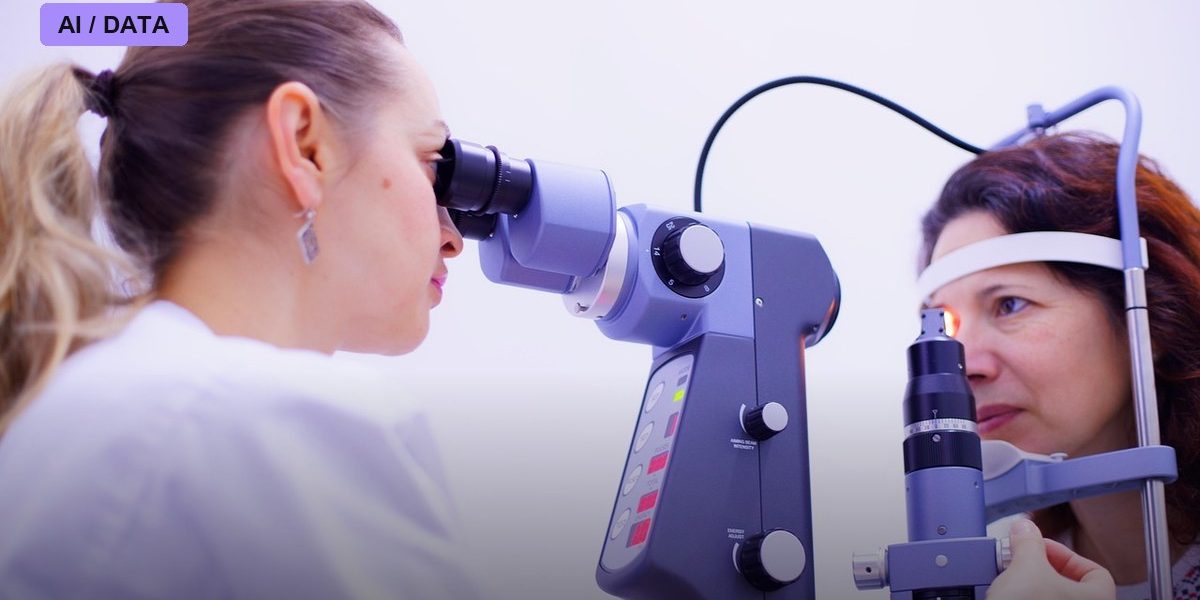
The U.S. Food and Drug Administration granted 510(k) clearance on July 8, 2026, to iPredict-DR, an artificial intelligence-powered screening software developed by New York-based health technology company iHealthScreen. The clearance, filed under submission number K253704, authorizes the software to analyze color retinal fundus images and automatically flag adults with diabetes who show signs of \”more than mild\” diabetic retinopathy, a leading cause of preventable blindness. The tool is designed to be paired with the iCare DRSplus fundus camera, a device the companies say can be operated by minimally trained healthcare staff rather than requiring a specialist photographer or an on-site ophthalmologist.
What iPredict-DR Actually Does
iPredict-DR works by scanning digital images of the retina captured during a routine office visit and using machine-learning models trained on large sets of labeled fundus photographs to identify patterns associated with diabetic retinopathy. Rather than requiring a dilated eye exam performed by an ophthalmologist, the software produces a rapid referable or non-referable result that a nurse, medical assistant, or primary care physician can act on immediately. Because the underlying iCare DRSplus camera is built for ease of use, the companies are positioning the combined system for deployment in settings that have historically lacked easy access to eye care, including community health centers, rural clinics, and endocrinology offices that see diabetes patients regularly but do not have ophthalmology staff.
Who Is Behind the Technology
iHealthScreen was founded and is led by Alauddin Bhuiyan, PhD, who called the clearance \”a defining milestone for iHealthScreen\” that reflects \”years of scientific innovation, clinical research, engineering excellence\” by the company’s team. In a separate statement, Bhuiyan framed the clearance around access, saying it \”reinforces our mission to make AI-powered retinal screening accessible in primary care and community healthcare settings, enabling earlier detection, faster referral, and helping prevent avoidable vision loss.\” The FDA clearance was supported by data from a clinical validation trial examining the software’s diagnostic performance, safety, and usability, according to companies involved, though full peer-reviewed sensitivity and specificity figures from that trial have not yet been published in a journal.
A Longstanding Access Gap in Diabetes Care
The clearance lands against a backdrop of persistently low eye-screening rates among people with diabetes. According to the Centers for Disease Control and Prevention, fewer than two-thirds of diabetes patients in the United States received a recommended eye exam within the preceding 12 months as of 2023, a figure that has remained largely unchanged over the past decade. The American Academy of Ophthalmology has separately estimated that roughly 60% of diabetics skip their annual eye exam altogether. With the International Diabetes Federation projecting that global diabetes cases will climb to 700 million by 2045, health systems are increasingly looking to automate parts of the screening pipeline rather than relying solely on limited ophthalmology capacity. Market researcher GlobalData has forecast that AI applications across healthcare broadly will reach a $57.4 billion valuation by 2029, with diagnostic imaging tools like iPredict-DR representing one of the more mature and commercially active segments of that market.
Enthusiasm From Retina Specialists
Reaction from ophthalmology has been notably positive, if measured. Amitha Domalpally, MD, PhD, described diabetic retinopathy detection as \”one of the earliest success stories for AI in medicine,\” and said she looks forward to a future in which \”a single retinal imaging encounter can reliably screen for the three major causes of irreversible vision loss\” — diabetic retinopathy, glaucoma, and age-related macular degeneration. That ambition tracks with iHealthScreen’s own stated roadmap, which includes plans to pursue additional FDA clearances covering AMD, glaucoma, hypertensive retinopathy, and even cardiovascular disease risk markers that can sometimes be inferred from retinal imaging.
A Note of Caution From Clinicians
Not every specialist has framed the clearance purely as a breakthrough. Sunir J. Garg, MD, FACS, FASRS, welcomed the potential of the technology but cautioned that it should not be mistaken for a substitute for specialist care. \”We need to remind the public and policy makers that screening with a fundus photo is no replacement for a comprehensive eye exam,\” Garg said. He added that if the technology proves \”easy to use, cost-effective, reliable and identifies patients who otherwise wouldn’t have an eye exam into our office before they have substantial visual loss, it would be great,\” but stressed that the goal should be increasing the total number of patients screened while continuing to advocate for those patients to eventually see an ophthalmologist for conditions that require specialist judgment. That distinction — between a triage tool that flags risk and a diagnostic exam that catches everything — is one that clinicians say policymakers and reimbursement systems will need to keep clear as autonomous AI screening tools proliferate.
What Comes Next
iPredict-DR is now commercially available in the United States, and iHealthScreen says it is working to expand distribution of the combined AI-and-camera system into primary care networks and community health organizations that treat large diabetic populations but lack in-house eye care. The clearance adds to a growing list of FDA-authorized AI tools for diabetic eye screening that has emerged over the past several years, intensifying competition among vendors seeking to embed automated retinal analysis into routine primary care visits. Whether that competition translates into meaningfully higher screening rates — rather than simply shifting where screening happens — will likely depend on reimbursement policy, primary care adoption, and continued validation of these tools in the real-world, non-specialist settings where they are now being deployed.
Photo: newarta / PIXABAY via Pixabay