Oura Builds Its First In-House AI Model, and It’s Entirely About Women’s Bodies
Oura launched its first proprietary AI model on February 24, 2026, built specifically to give personalized cycle, fertility, pregnancy and menopause guidance using a member’s own biometric data — all processed on Oura’s own servers rather than sent to outside AI providers.
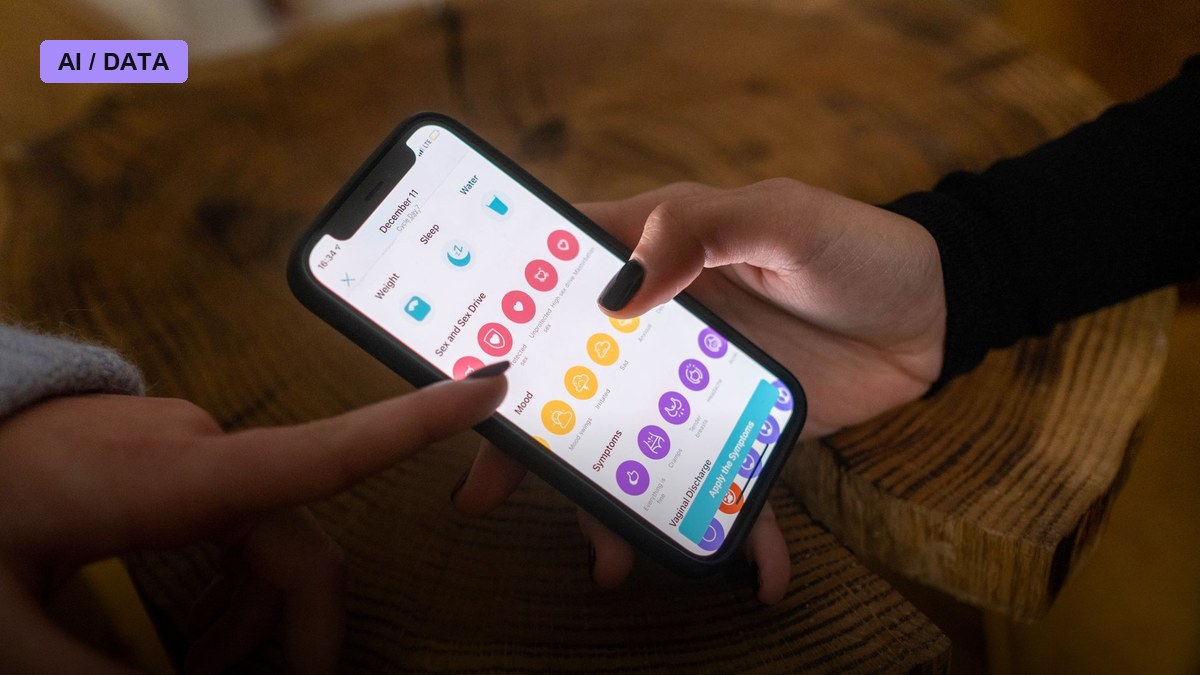
Oura has spent years telling women what their bodies are doing based on a ring’s worth of sensor data. Now it’s built an AI model whose entire purpose is figuring out what to tell them about it. On February 24, 2026, the company launched its first proprietary AI model dedicated specifically to women’s health, folding cycle tracking, fertility estimation, pregnancy monitoring and menopause guidance into a single system built and hosted entirely on Oura’s own infrastructure.
What the Model Actually Does
The new model lives inside Oura Advisor, the ring maker’s existing generative-AI assistant, but it’s a distinct system purpose-built for women’s physiology rather than a general wrapper around a third-party chatbot. When a member asks a question about their cycle, fertility window, pregnancy symptoms or menopause transition, the model cross-references a curated body of women’s health research alongside that person’s own longitudinal biometric trends — sleep, heart rate variability, temperature, activity and cycle data collected by the ring over months or years. The goal, according to Oura, is guidance that’s grounded both in published clinical literature and in what that specific user’s body has actually been doing.
Built by Clinicians, Reviewed by Clinicians
Oura’s Chief Medical Officer, Ricky Bloomfield, MD, framed the launch as a response to a long-standing gap in consumer health tech. Women’s health is too complex, and too often overlooked, to rely on one-size-fits-all systems, Bloomfield said. Chris Curry, MD, a board-certified OB/GYN who serves as Oura’s Clinical Director of Women’s Health, put the goal in more practical terms: the model translates complex science into clear, compassionate, always-available guidance. The underlying model and its outputs were reviewed by Oura’s in-house clinical and engineering teams alongside outside board-certified women’s health specialists before release.
Building on an Existing Track Record
The new AI layer sits on top of Oura’s existing Cycle Insights feature, which the company says has demonstrated ovulation-detection accuracy above 96% in results published in the Journal of Medical Internet Research. That accuracy claim matters for the fertility-window and pregnancy-monitoring features specifically, since those depend on correctly identifying where a user actually is in her cycle before the AI layer generates any guidance on top of it.
Privacy as a Selling Point
Oura is leaning hard into privacy as a differentiator, an area where health-focused AI products have repeatedly drawn scrutiny. The company says the women’s health model runs entirely on Oura-controlled infrastructure, that user conversations are never routed through third-party AI providers such as OpenAI or Google, and that conversation data is not sold, shared, or used to train external models. For a category of data as sensitive as menstrual and pregnancy tracking — which has drawn its own wave of state and federal privacy legislation since the overturning of Roe v. Wade — that infrastructure choice is as much a legal hedge as a marketing pitch.
The Skeptic’s View
Reproductive health researchers have welcomed better personalization tools but caution that AI-generated guidance on fertility and pregnancy carries real stakes if it’s wrong or overconfident. Consumer wearables have faced criticism in the past for cycle and ovulation predictions that don’t generalize well across women with irregular cycles, polycystic ovary syndrome, or perimenopause, precisely the populations that stand to benefit most from better tools. Because the feature is rolling out through Oura Labs — the company’s opt-in experimental feature hub — rather than as a fully validated clinical product, some public health experts argue it should be treated as a wellness aid rather than a diagnostic one, and that marketing language should make that distinction clearer to users making real reproductive decisions.
A Crowded, Fast-Growing Category
Oura’s move lands in a wearables market where women’s health has become a genuine competitive battleground, not a niche feature. Rivals including Apple, Samsung and a wave of venture-backed smart ring startups have all added or expanded cycle and fertility tracking over the past two years, betting that the roughly half of ring and watch buyers who are women represent an underserved, high-retention customer base.
What’s Next
Oura says the model will keep expanding as it gathers more usage data through Oura Labs, with menopause-specific guidance expected to deepen first given how little consumer health tech has addressed that life stage to date. Whether rivals respond with their own dedicated women’s health models — rather than folding the feature into general-purpose health chatbots — will be a signal of how central this specific demographic has become to the wearable industry’s next growth phase.
Photo: cottonbro studio / PEXELS via Pexels